

Recently, a research team led by Professors Song Qinghai and Chen Yimu from the School of Integrated Circuits at Harbin Institute of Technology, Shenzhen, made significant progress in the field of optoelectronic devices, offering new insights into electrically driven circularly polarized light sources.
Reports indicate that light-emitting diodes (LEDs) capable of directly emitting electrically driven circularly polarized light can meet the requirements of next-generation information technologies in miniaturization, integration, high speed, low power consumption, and multifunctionality. These LEDs hold great promise for applications in quantum information, advanced displays, optical communication and information security, and precision biomedical technologies.
For practical applications, such devices must exhibit excellent luminescence performance, particularly high external quantum efficiency (EQE), while also generating highly asymmetric circularly polarized light. However, mainstream organic circularly polarized light-emitting diodes (CP-LEDs) face challenges in simultaneously achieving both high optoelectronic performance and high emission asymmetry.
Thus, the development of high-performance CP-LEDs with strong emission asymmetry based on novel materials is essential for advancing next-generation information technologies. Chiral perovskite materials exhibit an efficient chiral-induced spin selectivity (CISS) effect, overcoming the limitations of low structural chirality and optical activity to generate highly asymmetric spin-polarized charge carriers. These spin-polarized carriers can directly recombine radiatively to emit circularly polarized light, presenting a new approach for constructing such devices.
To tackle these challenges, the Harbin Institute of Technology research team conducted an in-depth study of the existing issues in spin-LEDs based on chiral perovskite materials and proposed a spin-polarized exciton device operation model. By following a systematic approach of "working mechanism – material regulation – device optimization," they successfully developed perovskite spin-LEDs that achieve both high emission asymmetry and high external quantum efficiency.
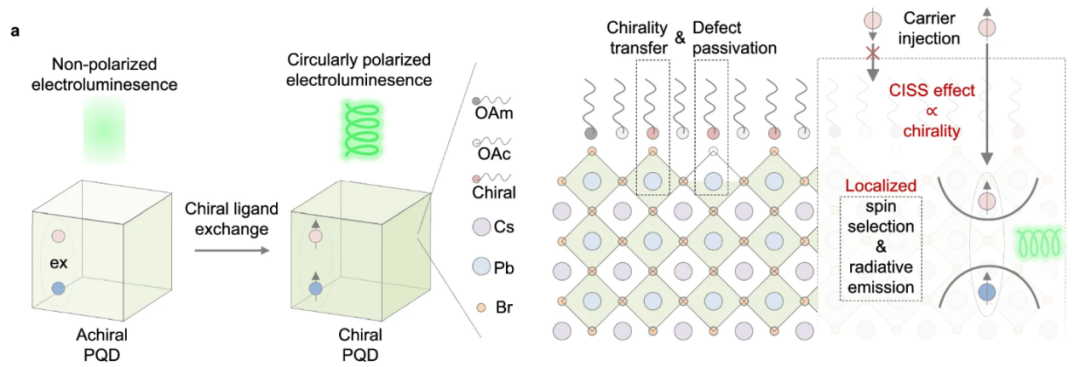
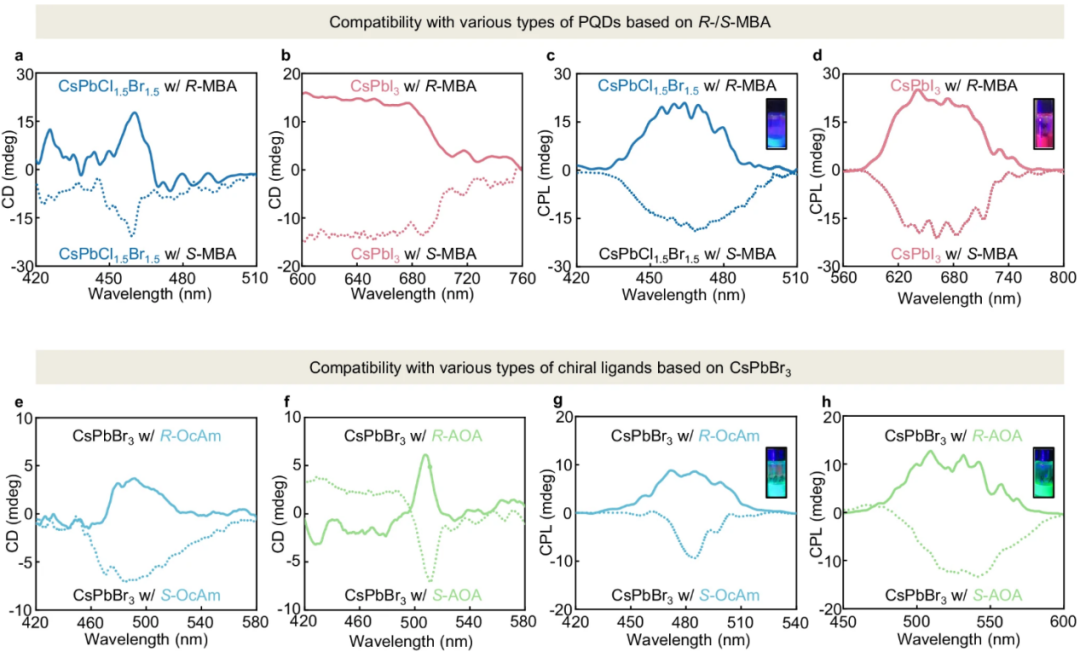
The research team conducted a systematic study on the structure-property relationships of chiral perovskite quantum dot materials, with a particular focus on their optoelectronic properties and chiral/spin polarization capabilities. As a result, they successfully developed chiral perovskite quantum dots with outstanding optoelectronic performance and highly efficient spin polarization selectivity, capable of emitting circularly polarized light across multiple wavelengths.
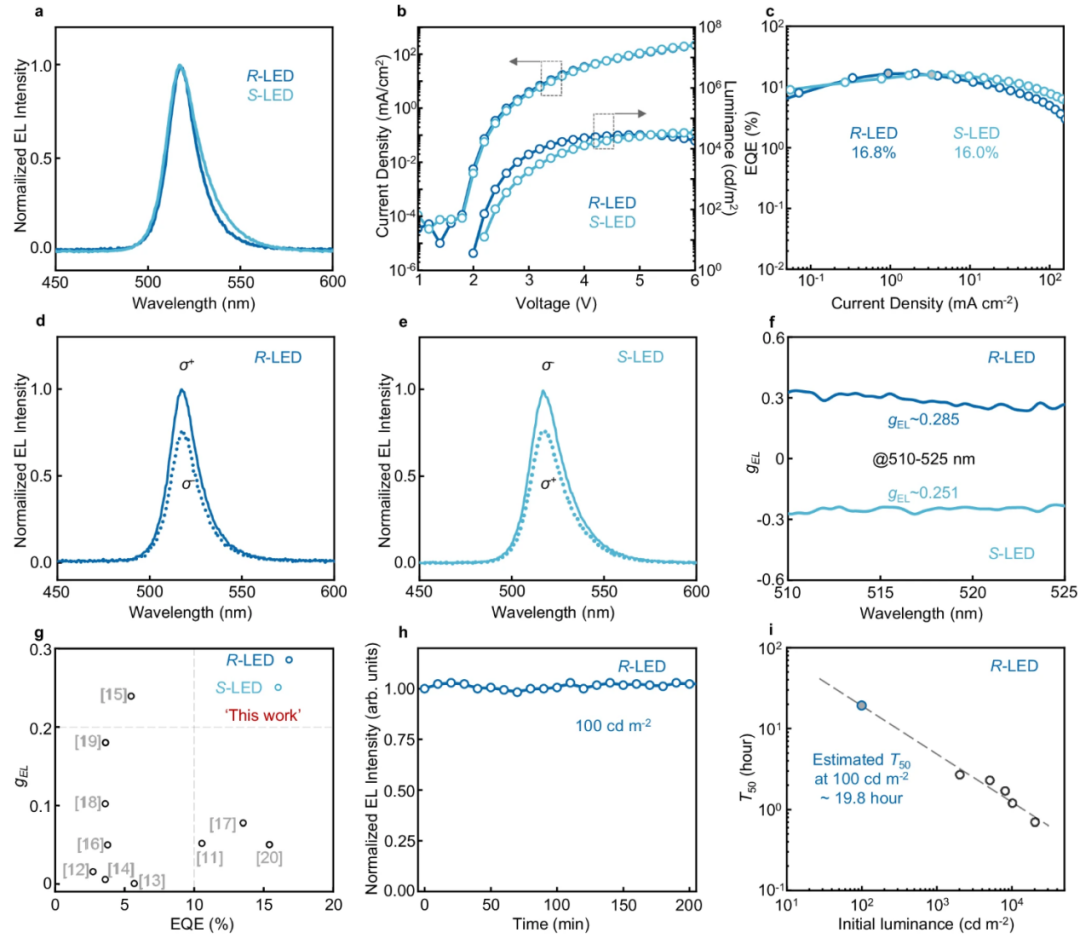
Following the approach of "working mechanism – material regulation – device optimization," the research team successfully developed a chiral perovskite quantum dot spin light-emitting diode (LED) that simultaneously achieves excellent optoelectronic performance and high luminescence asymmetry. The device demonstrated an electroluminescence asymmetry factor of 0.285, an external quantum efficiency of 16.8%, a peak brightness exceeding 28,000 candelas (cd) per square meter, and a T50 stability of 19.8 hours (with an initial brightness of 100 candelas per square meter). These performance metrics set new records in the field of chiral perovskite spin LEDs, highlighting their great potential for high-performance chiral light source applications.
This study was supported by projects such as the National Key Research and Development Program, the National Natural Science Foundation, the Guangdong Provincial Basic and Applied Basic Research Fund, and the Shenzhen Science and Technology Program.